
The Event: A Meeting of Minds
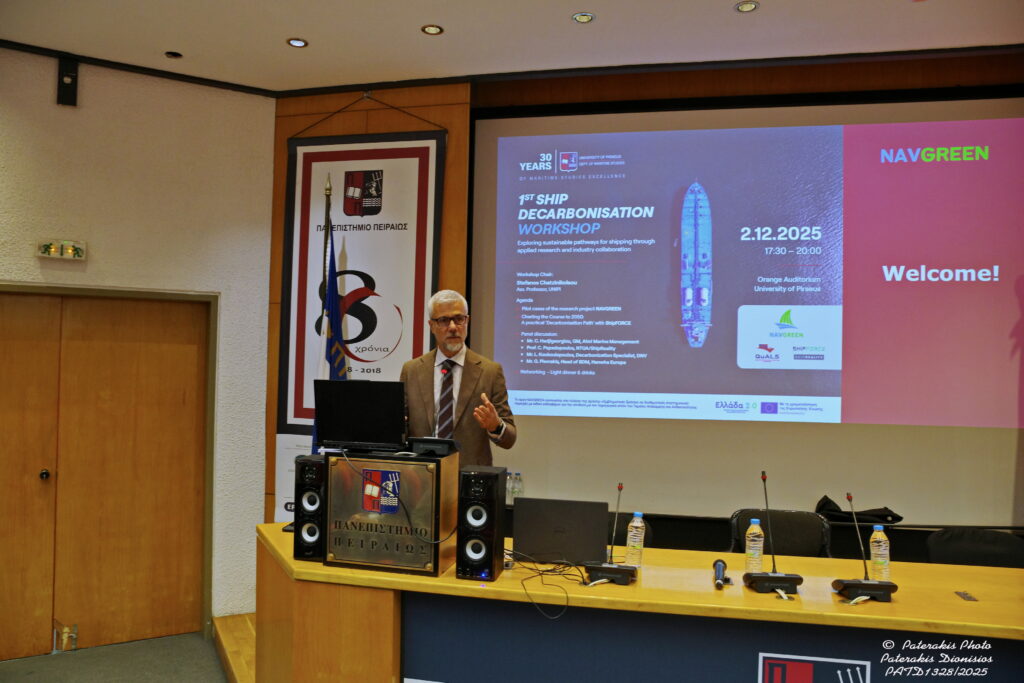
Yesterday, the ShipReality team attended the 1st Ship Decarbonisation Workshop. The event was hosted at the University of Piraeus (UniPi) on Tuesday, December 2, 2025.
It was organized by Assistant Professor Stefanos Chatzinikolaou, a key partner in the NAVGREEN project. Consequently, the workshop brought together a diverse group of experts. The audience included technical managers, engineering firm executives, ESD providers, and PhD researchers.
The theme was critical. Specifically, it focused on “Decarbonization pathways through 2050.”
The atmosphere was buzzing with a mix of urgency and innovation. There was a clear consensus that the industry needs sharper signals from regulators regarding decarbonization. However, there was also a realization that we cannot wait for 2050 to act. Shipping companies need tools to make decisions today.
For this reason, we were there.
Introducing “Decarbonization Path”
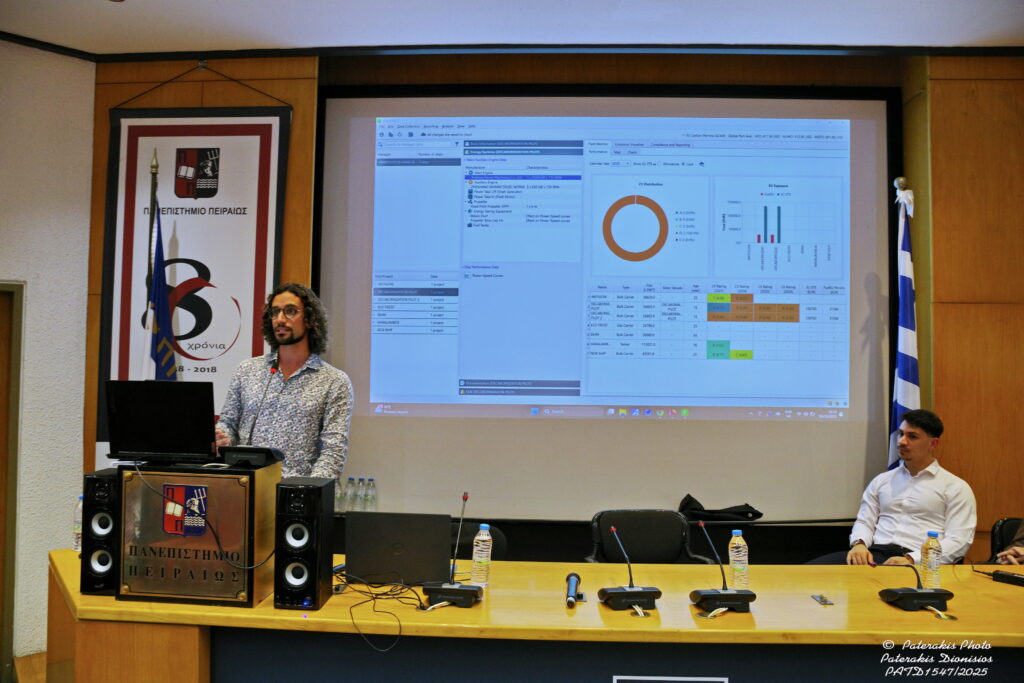
During the workshop, our CTO Christos Papadopoulos and Senior Developer Markos Papatheodorou took the stage. They unveiled the latest addition to our ShipFORCE emissions analytics software: the Decarbonization Path module.
In fact, we built this module to solve a specific, painful problem in the industry: Complexity.
Currently, evaluating Energy Saving Technologies (ESDs) is a slow, manual process. Furthermore, it is often filled with uncertainty. The Decarbonization Path module changes this. Now, users can perform rapid techno-economic evaluations of ESDs based on the actual service profile of their vessel.
For example, key capabilities include:
- Rapid Assessment: Assess ESDs using real ship data instantly.
- Future Projections: Project performance through 2050.
- Regulatory Calculation: Automatically calculate benefits from reduced fuel consumption. Additionally, it calculates environmental penalties like EU ETS and FuelEU Maritime.
Bridging Industry and Academia
One of the proudest moments was seeing the synergy between our software engineering and academic rigor.
ShipReality developed the “Decarbonization Path” module as a commercial tool. However, its methodologies were sharpened through collaboration. Researchers from UniPi and NTUA (National Technical University of Athens) tested the tool. Subsequently, they provided high-level feedback that we incorporated into the final logic.
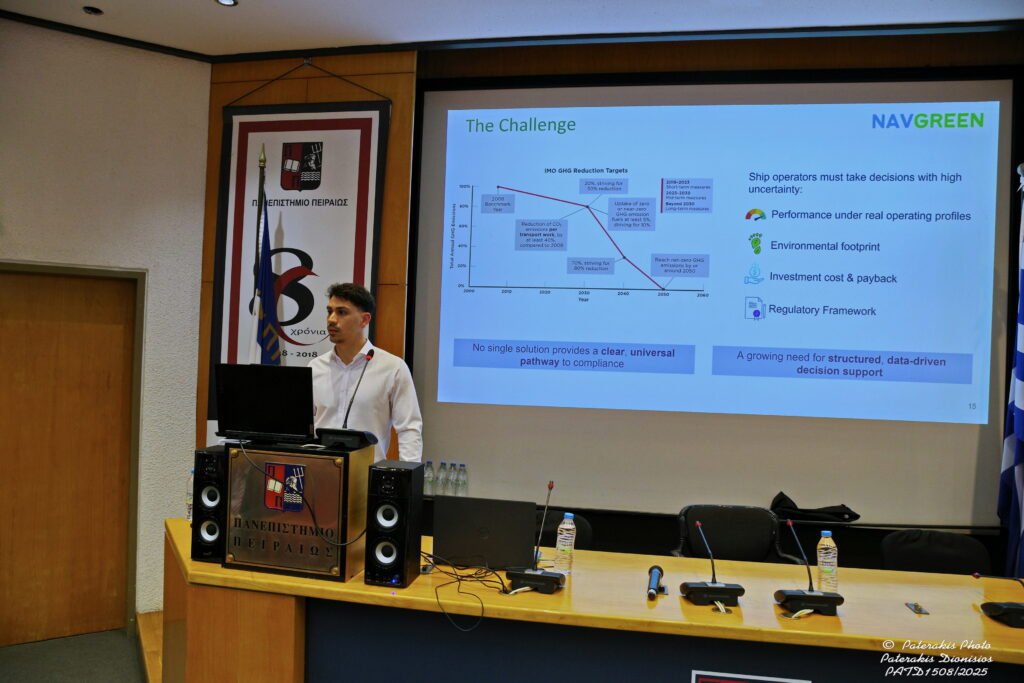
As a result, the proof was in the pudding. Konstantinos Papaefthymiou, a PhD candidate at UniPi, took the stage to present results from the NAVGREEN project. He demonstrated how he is currently using ShipFORCE’s new module to analyze data.
Seeing a researcher validate our tool live on stage drove the point home. Ultimately, ShipFORCE isn’t just a reporting tool; it’s a decision-making engine backed by scientific methodology.
A Glimpse into the Future: ShipHULL
The “Decarbonization Path” is available right now. Nevertheless, we couldn’t resist giving the audience a sneak peek at what’s coming next.
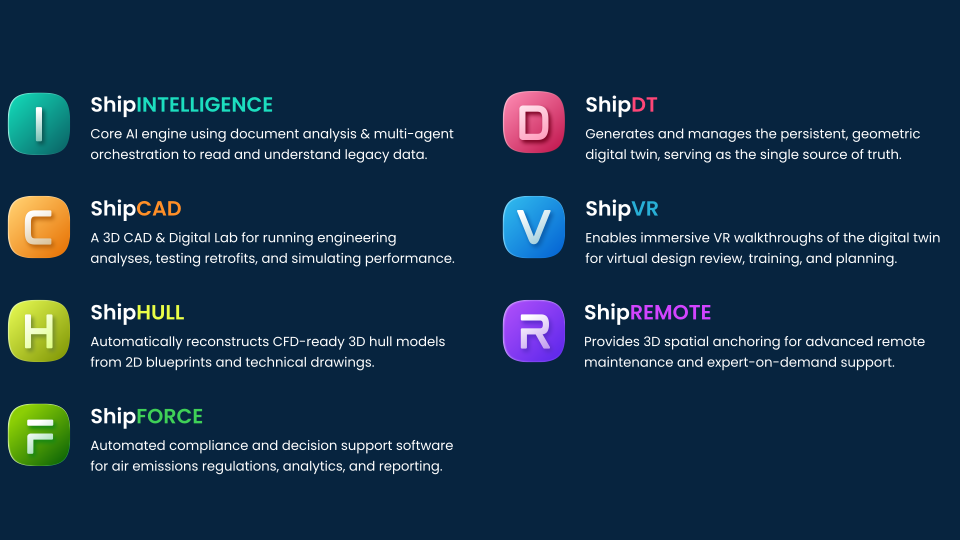
Our CTO, Christos Papadopoulos, pitched our vision for ShipHULL. This is an upcoming innovation designed for automated hull reconstruction from 2D drawings.
The reaction from the technical managers in the room was palpable. Indeed, it confirmed that we are moving toward digital twins and advanced retrofitting. Therefore, the ability to rapidly digitize legacy fleet data will be a game-changer.
The Takeaway
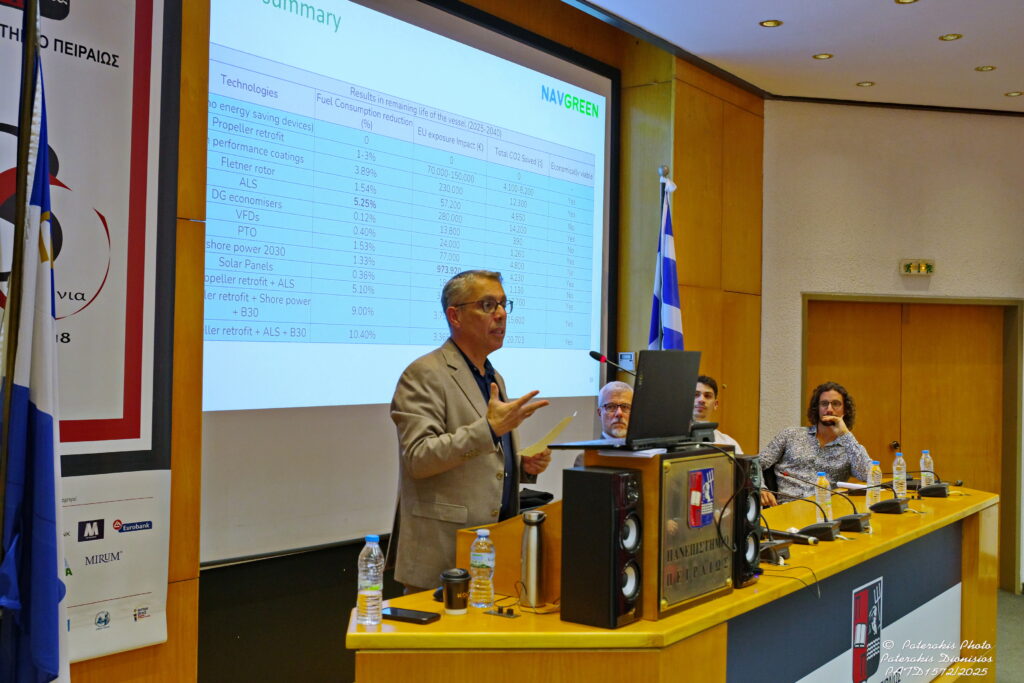
The 1st Ship Decarbonisation Workshop confirmed that the path to 2050 is complex. But it is navigable with the right tools.
You might be a shipowner trying to calculate EU ETS exposure. Alternatively, you might be a technology provider proving the ROI of your ESD. In either case, you need models and data you can trust.
We want to thank the University of Piraeus and the NAVGREEN project team for a fantastic event.
Ready to evaluate your fleet’s path to 2050? The Decarbonization Path module is available now in the latest version of ShipFORCE.