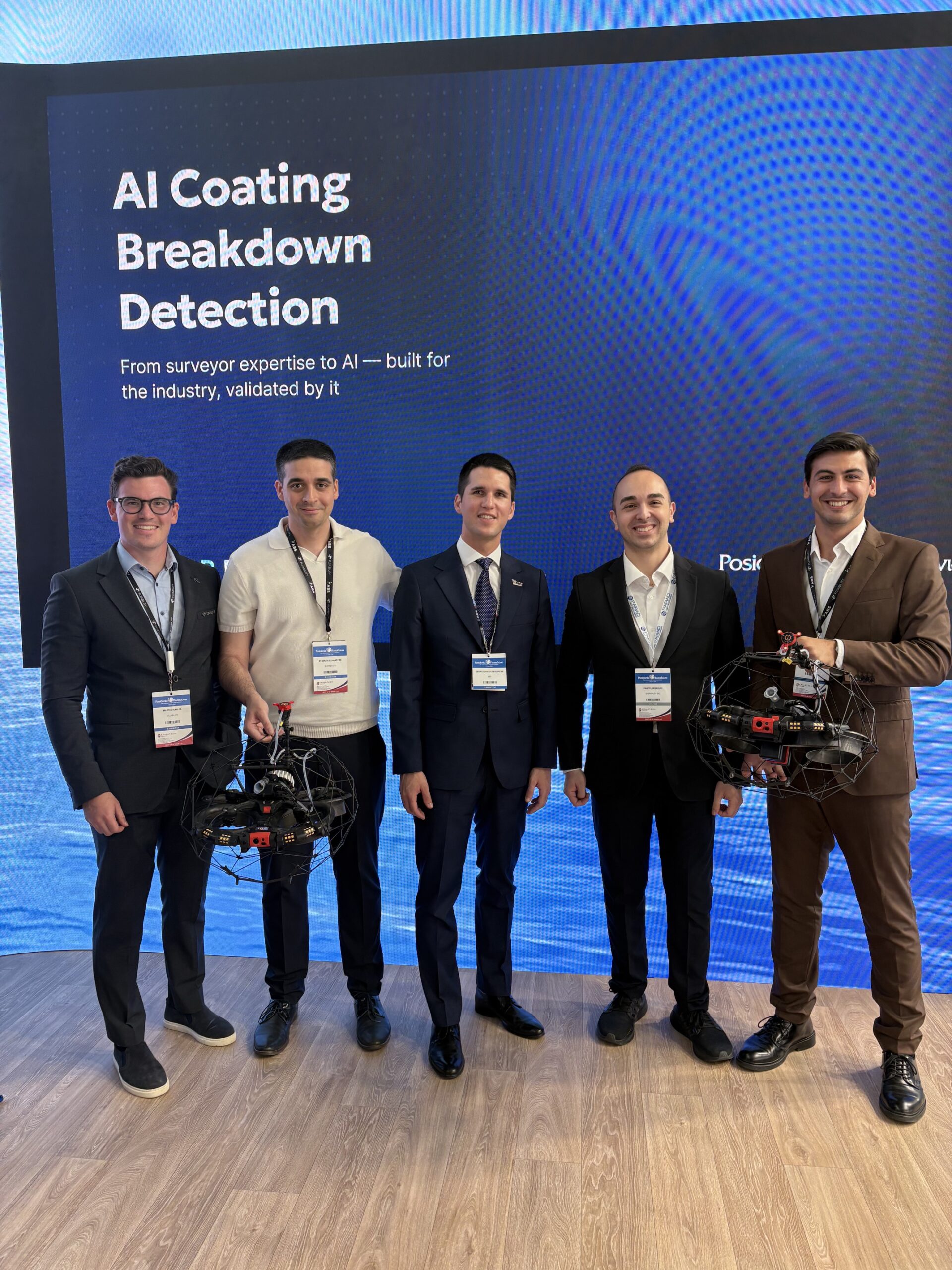
Posidonia 2026 was the stage for a demonstration that brought together three independent technologies to solve one of shipping’s most persistent challenges: understanding, measuring, and acting on coating breakdown inside ship structures.
ShipReality, in collaboration with the American Bureau of Shipping (ABS) and Flyability, demonstrated a complete end-to-end workflow — from drone flight to AI detection to digital twin area quantification — live on the exhibition floor.
Here is exactly what happened, and why it matters.
Setting the Stage: ABS and the Case for AI-Powered Inspection
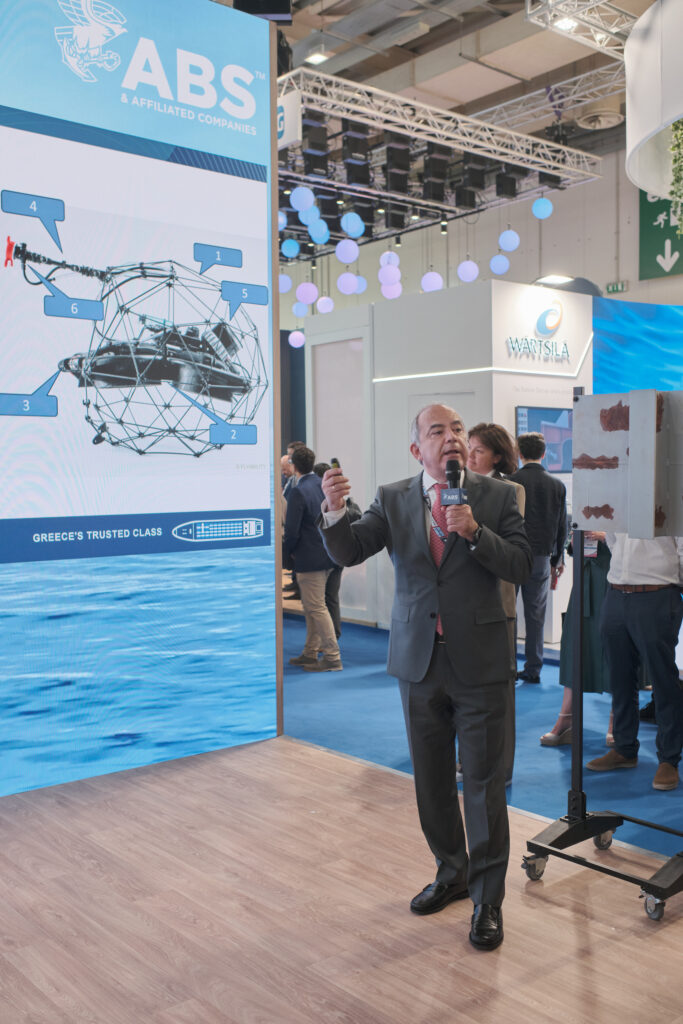
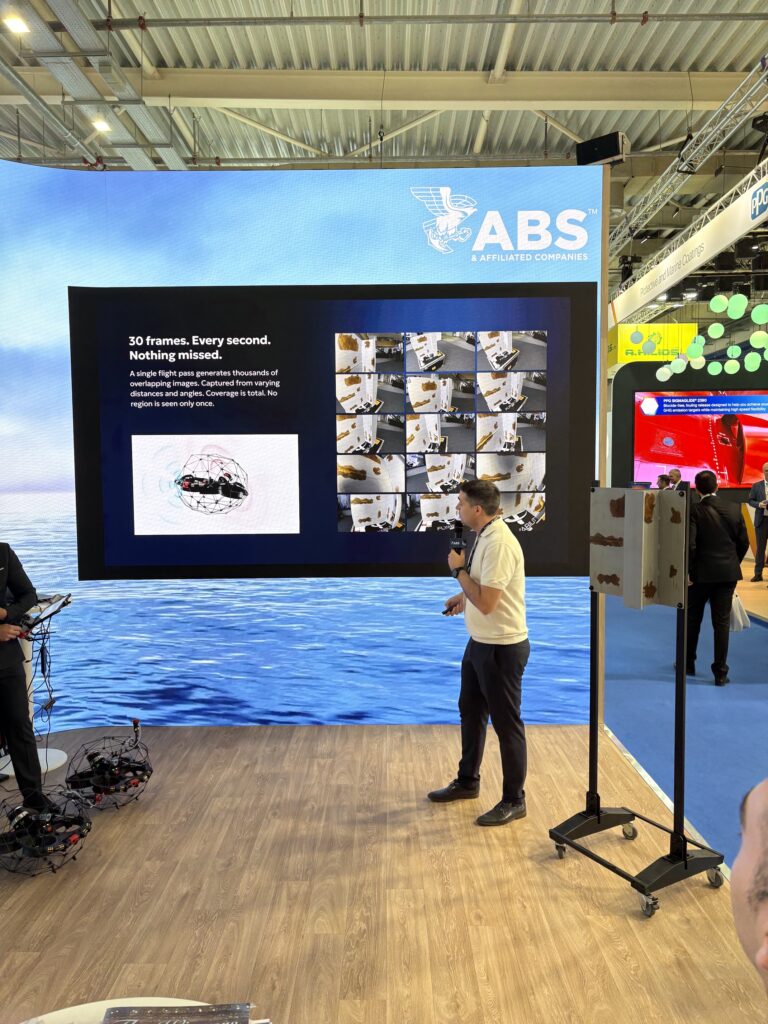
The demonstration opened with Dr. Christos Leontopoulos from ABS, who presented the Society’s ongoing work with Flyability in advancing Remote Inspection Techniques (RIT). Using Flyability’s Elios 3 drone, ABS has been conducting successful onboard demonstrations for Ultrasonic Thickness Measurement (UTM) — pushing the boundaries of what’s possible in confined, GPS-denied spaces inside ship structures.
Dr. Leontopoulos then framed the next frontier: inspection surveys can already put a drone inside a tank. The question is — what do you do with what the drone sees? Specifically, can you teach a machine to understand coating condition from drone footage, and can you turn those detections into actual, measurable data?
That question is precisely what ShipReality set out to answer.
The ShipReality Approach: From Pixels to Area
Training on Reality
ShipReality’s AI model was trained on real inspection imagery — not synthetic data, not laboratory renders. Crucially, the model’s development was guided by surveyors with decades of field experience, ensuring that what the model learns to detect reflects what actually matters in a professional inspection context.
The result is a model that performs robustly across the varied conditions drone footage presents: different distances, different angles, different lighting — the full range of what a drone encounters as it moves through a ship’s interior.
The Drone Challenge: 30 Frames Per Second
When you mount an AI model on a drone that captures 30 images for every second of flight, you unlock something significant: comprehensive, systematic coverage of every structural element and every defect, without gaps, without fatigue, without the constraints of manual inspection positioning.
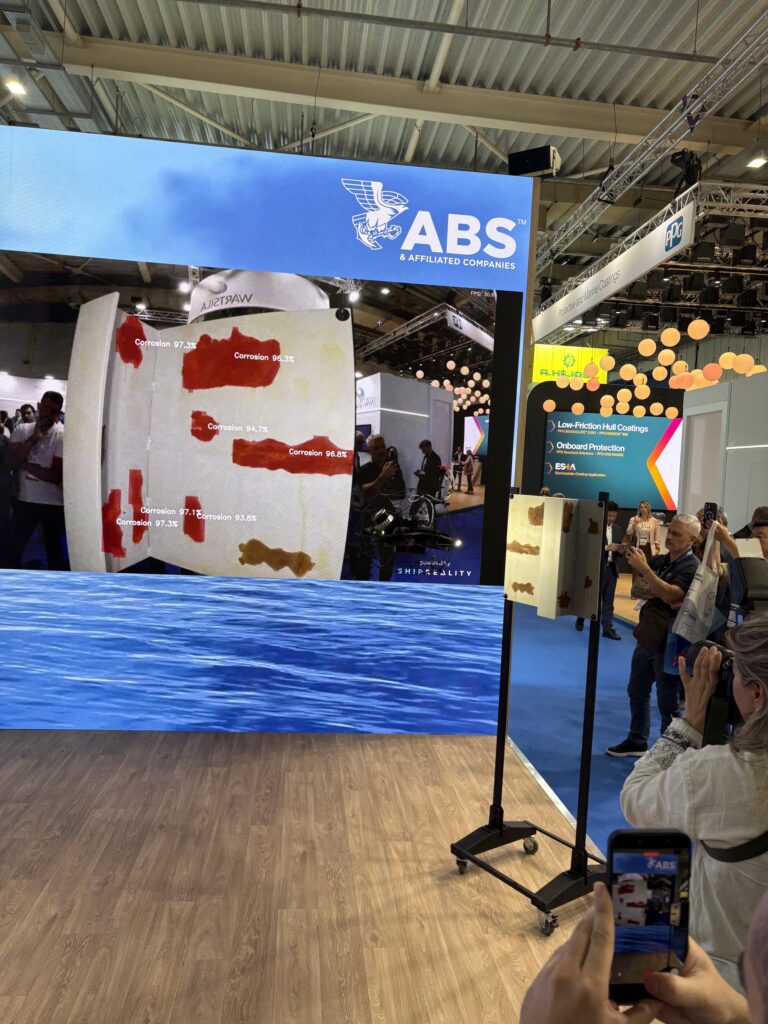
During the Posidonia demonstration, the model ran in real time at 30 frames per second — correctly identifying all coating breakdown areas on the test plate as the Elios 3 flew its path. In production deployments, the workflow will be asynchronous, with larger, more powerful models processing the full 30fps footage to deliver even greater accuracy and detail.
From Detection to Measurement: The Digital Twin
Detecting coating breakdown is the first step. Measuring it — calculating the actual percentage of affected area — requires something more: a geometric reference that knows the shape, dimensions, and structure of what the drone is looking at.
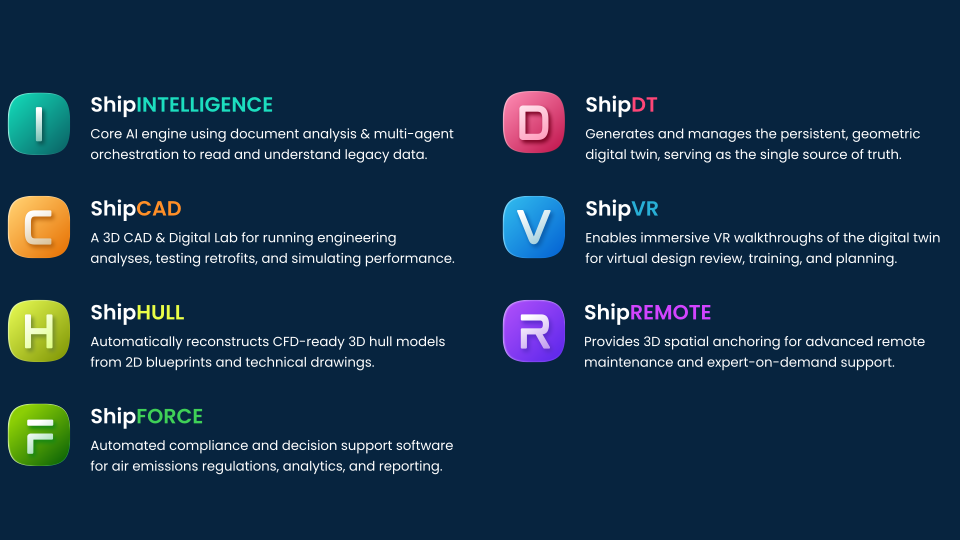
This is where ShipReality’s digital twin software, ShipHULL, becomes essential.
For the demonstration, the team created a digital twin of the test plate — a real 50×50 cm steel plate with a T-junction and genuine coating breakdown. ShipHULL, which generates 3D ship models from 2D drawings in a fraction of the time traditional methods require (a full hull model that would take four days can be produced in four hours), provided the geometric foundation.
The digital twin was then registered with the LiDAR point cloud data captured by the Elios 3 during its flight — a semi-automatic process that aligns the 3D model with the drone’s spatial data. Once registered, every coating breakdown detection from the AI was mapped directly onto the surface of the digital twin.
The output: a precise, spatially-accurate calculation of the affected area — not an estimate, not a visual impression, but a number grounded in geometry.
Why This Changes Maintenance Decision-Making
A digital twin with mapped coating breakdown data is not just a reporting tool. It is a living asset. Layers for coating condition, thickness measurements, structural deformations, and repair history can accumulate over time — turning each inspection into a data point in a continuous understanding of the vessel’s condition. This enables maintenance planning that is proactive, targeted, and defensible.
The Live Demonstration
The AI Detects
Flyability flew the Elios 3 past the test plate. ShipReality’s model processed the footage in real time. The coating breakdown areas — visible to the eye, but now also visible to the machine — were correctly identified across the plate surface, including around the T-junction.
The audience watched it happen live.
Ultrasonic Thickness Measurement
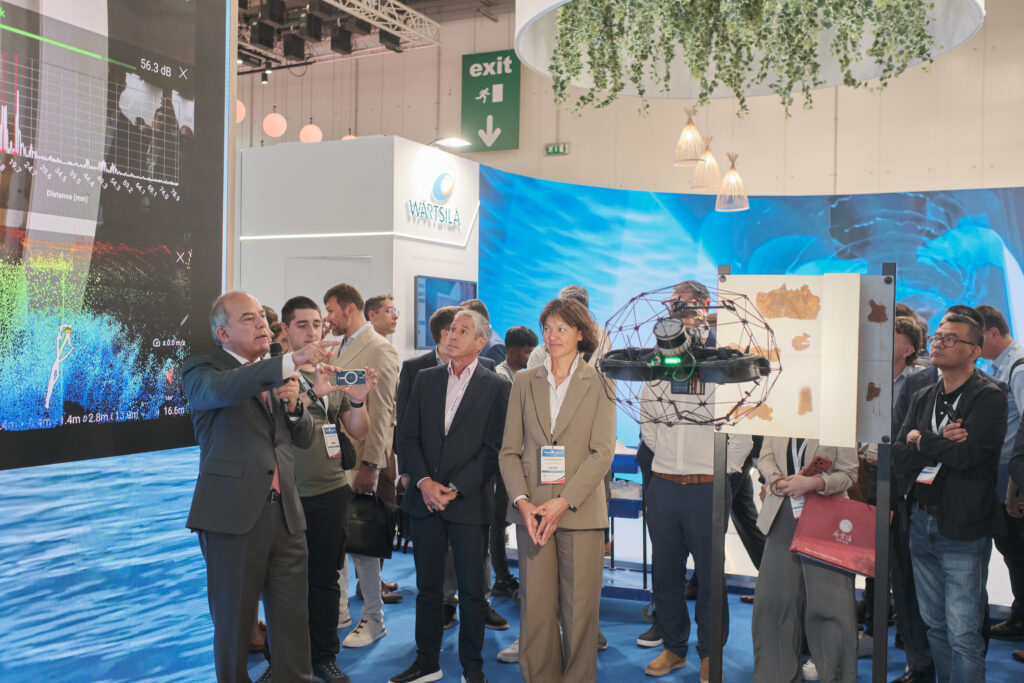
Flyability followed with a second demonstration: accurate ultrasonic thickness measurements of the same plate, captured by the Elios 3. This underscored the complementary nature of the technologies on display — visual AI analysis and precise physical measurement, delivered by the same drone platform.
Three Technologies. One Workflow.
What Posidonia 2026 demonstrated is not a single product. It is a convergence:
- ABS brings the regulatory framework, survey expertise, and the industry trust required to validate new inspection methodologies.
- Flyability brings the hardware — a drone platform capable of operating safely in confined, GPS-denied spaces while capturing both visual and LiDAR data and performing UTM.
- ShipReality brings the intelligence layer — AI-powered coating breakdown detection, and the digital twin infrastructure to turn detections into measurements and measurements into decisions.
Each party operates independently. Together, they demonstrated something the maritime industry has not seen before: a complete, automated pathway from drone flight to quantified coating condition — live, on a real structural element, at one of the industry’s most prominent gatherings.
What Comes Next
The demonstration at Posidonia is a proof of concept — a rigorous, live one, but a beginning. ShipReality is actively working toward production deployments of this workflow on real vessels, with the digital twin infrastructure of ShipHULL supporting coating analysis alongside its existing applications in hull and propeller modelling.