
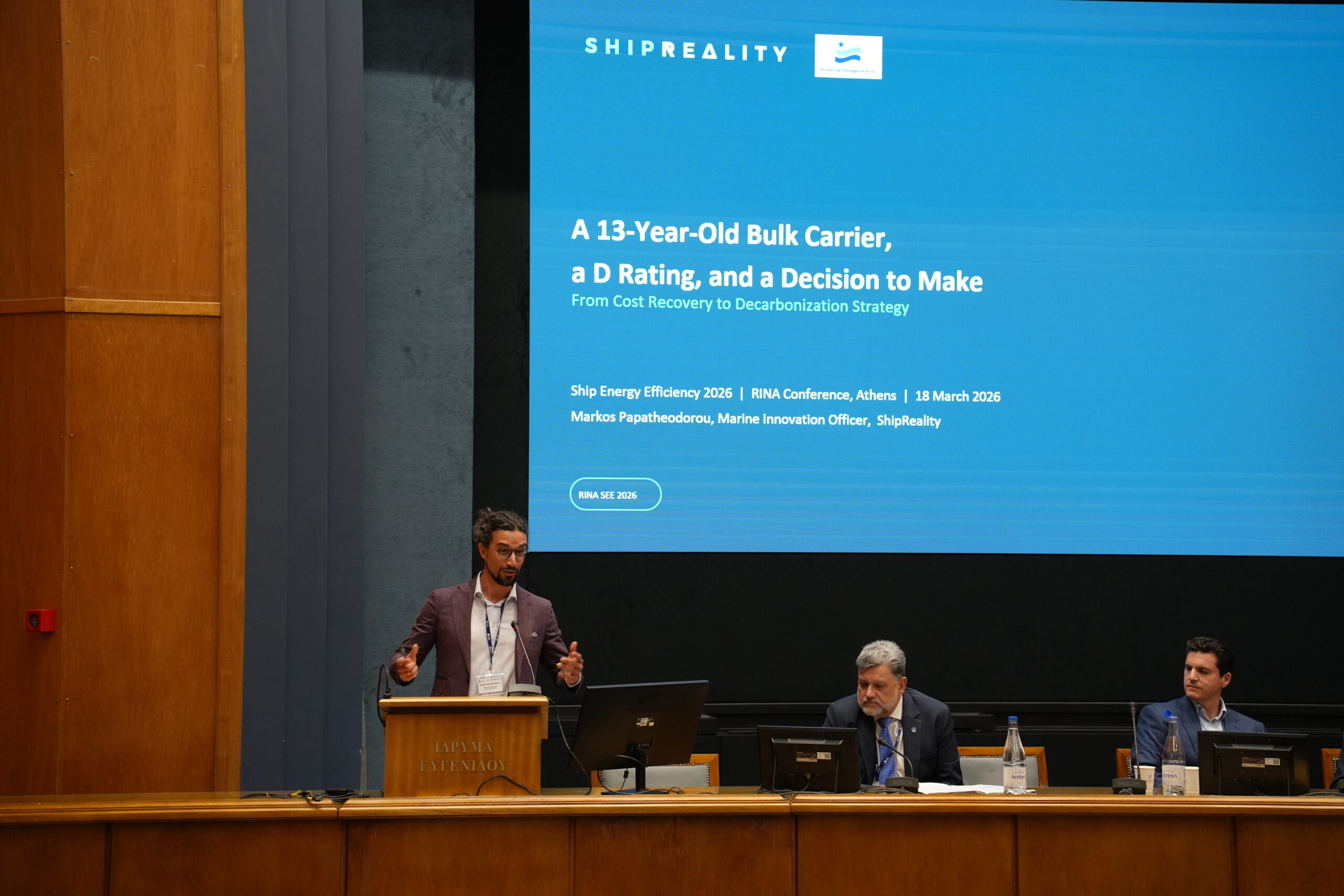
ShipReality was at RINA SEE 2026 — the Royal Institution of Naval Architects’ Ship Energy Efficiency Conference in Athens — and our Marine Innovation Officer, Markos Papatheodorou, presented in the Digitalisation session on Day 2.
The conference brought together naval architects, fleet operators, technology providers, and regulators for two days of technical sessions. Topics covered wind-assisted propulsion, digital performance systems, and the hard commercial realities of decarbonisation. In short, it was exactly the kind of room where the gap between theoretical compliance and practical fleet management gets examined honestly.
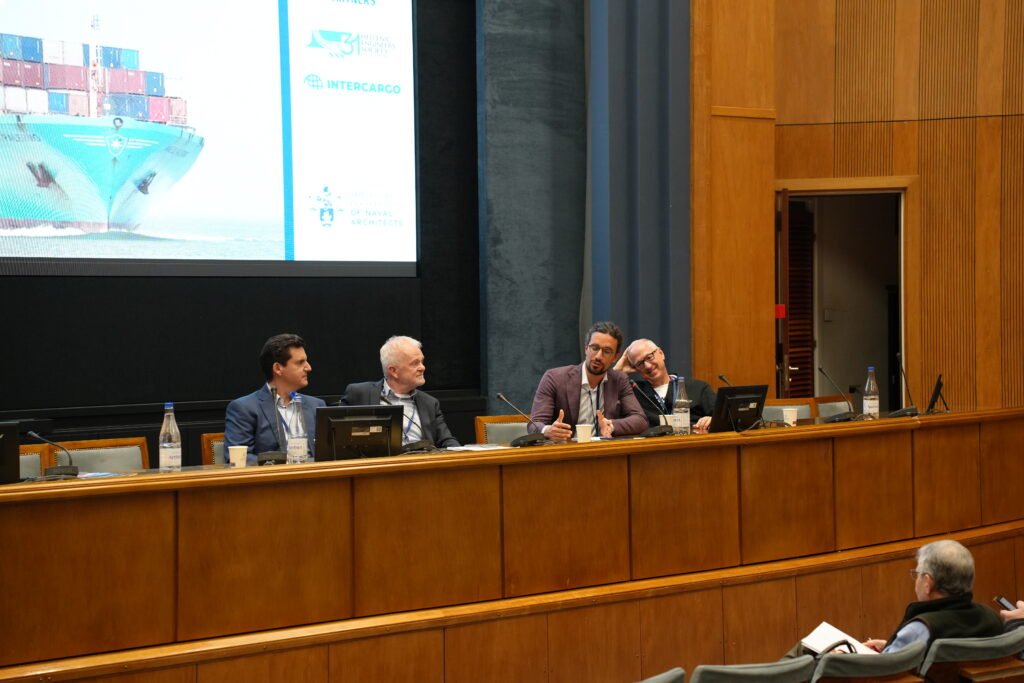
Markos’s presentation was titled: “A 13-Year-Old Bulk Carrier, a D Rating, and a Decision to Make.” It addressed a scenario that is increasingly common across the global fleet. Specifically, it broke the problem into two parts that any operator facing a D or E rating will recognise.
Part 1: What ShipReality Brought to RINA SEE 2026 — Cost Recovery
The starting point of the presentation was a question that often gets skipped in the rush to talk about technology: before making any decision about the future, do you have a precise, verified picture of what the vessel already owes?
EU ETS allowances, FuelEU Maritime penalties, and CII rating consequences all fall on the owner. However, the charterer controls speed, routing, port calls, and fuel selection. That asymmetry is where unrecovered cost lives — and it compounds every year as the regulatory stack tightens.
ShipFORCE addresses this at the data infrastructure level. Not as a monitoring dashboard, but as the pipeline that makes verified cost recovery possible:
Noon Report Validation catches errors at source — before they propagate into regulatory submissions and settlements that become difficult to defend.
Digital Vessel Instance models the vessel from sea trial data, power curves, and SFOC characteristics. The physics-based benchmark against which all analysis runs. Without this, you are modelling an approximation — not your vessel.
MRV Decomposition allocates fuel consumption precisely across every berth, anchorage, manoeuvring, and at-sea segment. The auditable artefact that underpins every EU ETS and FuelEU settlement.
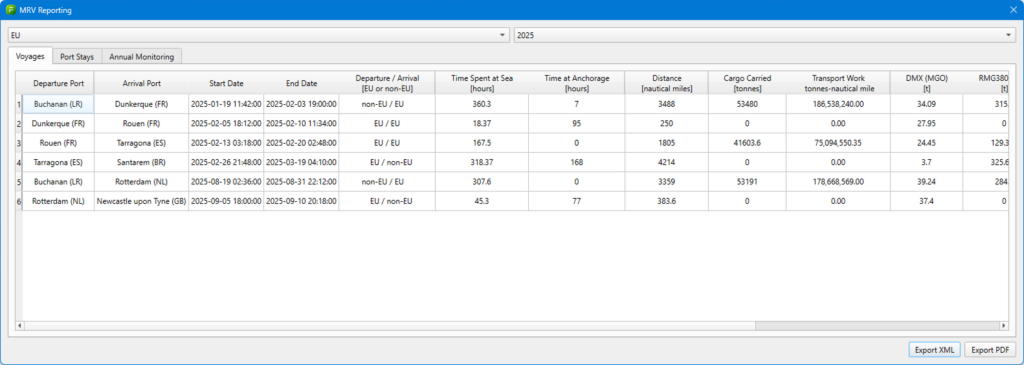
ShipFORCE’s calculation methodology is independently verified by Verifavia — meaning the engine is sound and the approach is auditable.
Part 2: Decarbonisation Strategy — Simulating What Actually Works
The second half of the presentation moved from cost recovery to forward planning — and this is where the conference audience engaged most directly.
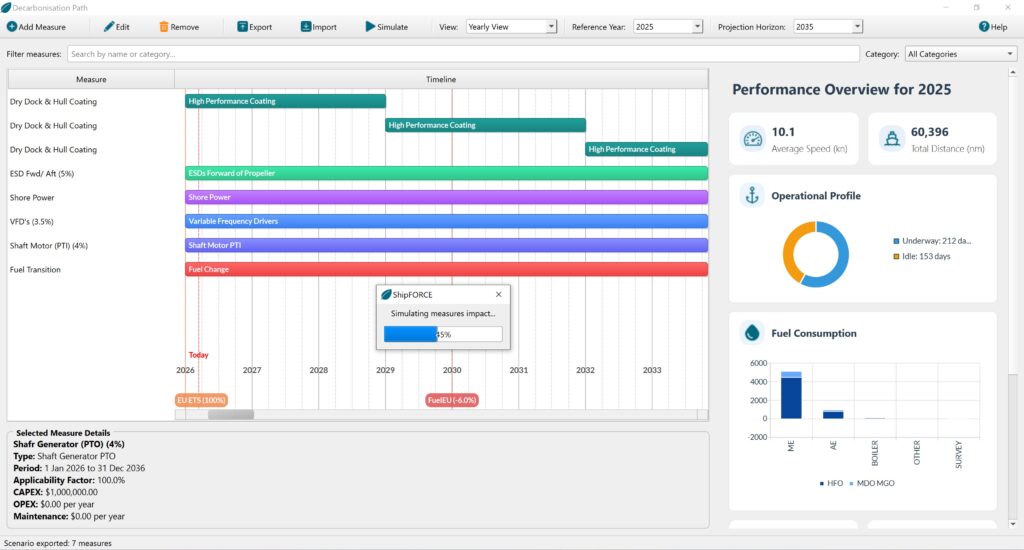
Stacking energy-saving technologies without physics-aware modelling produces decisions built on numbers that will not hold. ESDs interact. Their effectiveness degrades at different rates depending on trading pattern and fouling exposure. Vendor claims for individual products do not account for the combined effect — or the counter-impacts — when multiple measures are applied in sequence.
ShipFORCE addresses this properly. Specifically, it compares three states of the same vessel:
The original vessel — real operational data from noon reports, power curves, and actual trading profile.
The baseline vessel — a Business-as-Usual projection: if no action is taken, how do fuel consumption, emissions, and compliance costs evolve through the vessel’s remaining service life?
The retrofitted vessel — a digital twin where ShipFORCE applies energy-saving packages in sequence, with full accounting for fouling penalties, measure interactions, and diminishing returns.
Run across multiple stacked scenarios, this framework gives operators a clear, financially grounded view of what each investment actually delivers — before any capital is committed. As Markos put it during the session: “A tool that tells you ‘don’t invest’ is as valuable as one that tells you ‘invest here.'”
Key Takeaways
- Regulatory cost recovery requires a verified, auditable data pipeline — not a monitoring dashboard
- The owner/charterer asymmetry is the central commercial challenge of decarbonisation under the current regulatory framework
- Physics-aware simulation with degradation and counter-impact modelling is the minimum standard for any capital decision
- A simulation that tells you not to invest is as valuable as one that tells you where to invest
- High-fidelity hull modelling matters when the decision involves significant CAPEX
